22 August 2010
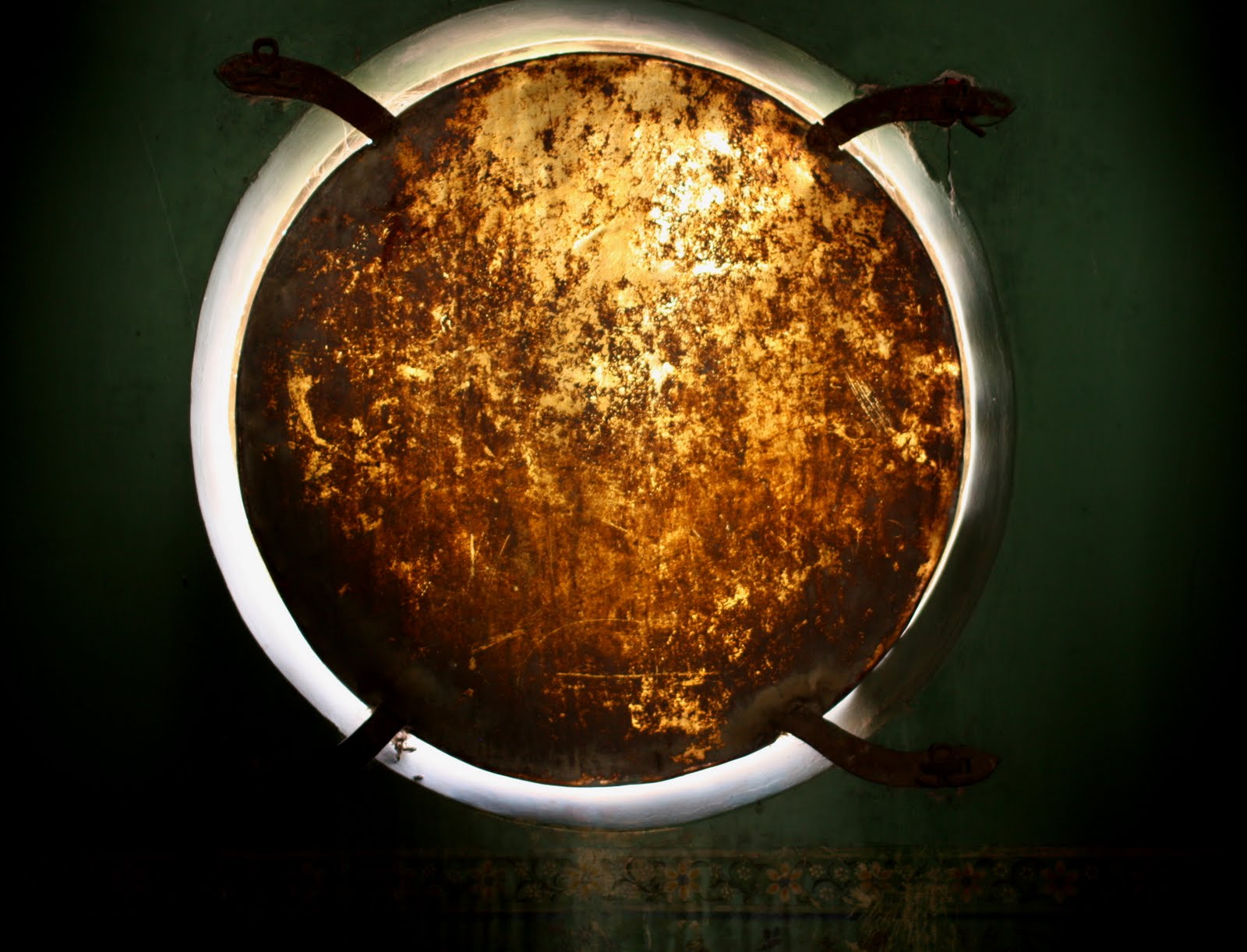
I was puzzled by this glowing-shield-thing. Then I discovered that the rulers of Udaipur once considered themselves sun-kings. Armed with this fact I found references to their solar lineage littered throughout the palaces of Udaipur, just in case they or their subjects forgot. Sun-king.... Hmmm.... Given it was about 50 degrees the day I was there I think I'd prefer to be a cloud-king.

Pinkish
Grace under shower
Back...
Bidip was silent for a few months. Some wondered whether delhi's summer had hardbaked my will to write. They're not far wrong. Delhi in summer is a tough place. The Brits escaped to the hills. And the modern Indian middle class escapes to the south of France or New York or wherever their diaspora connections take them. I escaped to ANYWHERE air-conditioned. But now the monsoon has broken, and the city is livable once more, I feel like sharing my stories again.
Today I visited old Delhi, a place that restores my faith in India like nowhere else. I played a few overs of laneway cricket, and smiled at strangers, and soaked up the wondrous multiplicity of the place. It is everything at once, woven, mosaiced and trampled into one. South Delhi with its posh shops and shiny cars feels like another country, separated by choice and chance. The latter is more pleasant by most metrics, but the raw goodness of old delhi draws me back again and again. People with nothing, and no agenda, are so disarmingly friendly. And the walls and cars and sunglasses of south Delhi, which inhibit so much communication, are gone. When I leave India it will be the smiling chai wallahs and the cheeky kids that I will remember, not the shiny malls or blinged up frumps in german sedans.
4 April 2010
Old-school chai wallah..
Summer is here, so the frequency of my interaction with the chai wallahs of northern India is likely to dip a little. I shall soon begin my 'tales of the pani wallahs.' But for now, here is one of Rajasthan's most popular men-of-chai, Mr B.R.Choudhuri of Kerwa village. He can be found at a truck stop somewhere between Jodhpur and Pali. B.R is notable because he retains the old-school clay serving cups, which by reputation add much flavour to the sugary tea. Mine certainly had a little more smokiness than usual and when i got to the bottom I could see the charcoal residue of an open fire. While we sipped a villager was unloading thousands and thousands of these clay cups into a storage shed. I asked B.R whether these would last him a month and he laughed loudly in a 'where-did-this-amateur-come-from' sort of way. "Three days" he said, "a thousand cups a day". I handed the empty cup to B.R with thanks, but he gestured for me to throw it away so I placed it on the ground gently. But B.R said "no, smash it." So I did. When I went for a post chai pee, (Me: "where is the bathroom?", Driver: Bathroom is everywhere sir") I stumbled across the evidence of the thousand chais out back. 100% biodegradable, though I note that not all B.R's clients were forced to smash their cups violently on the ground. Such fun can be had with foreigners eh!
In search of a pitched roof
When I first arrived in Delhi I was struck by the glorious straight lines of the rooftops, as though every centimetre of height allowed by building regulations was being utilised. I played 'spot the pitched roof' - and I'm still looking. When I return home I'll try the reverse - 'spot the indigo washed walls'. I suspect the strike rate will be similarly low, sadly.
3 April 2010
28 March 2010
Running Backwards Man
Delhi has many mysteries. One that I'm yet to see featured in a William Dalrymple book is Running Backwards Man, who does his 'retro-running' on Shantipath (one of Delhi's grand boulevards). Here he is. Note his most excellent headphones and wrist bands (in national colours which begs the question... is there an Indian running backwards team and if so who do they compete against?)

I googled 'running backwards' to see if anyone else was this nuts. It turns out backwards running is a more than a sport - it is a social movement. Here is a sample -
Well how about that! I guess that makes me, a forward runner, part of the embedded 'escapist movement.'
And then I discovered this... an awesomely amateur video demonstration of Delhi's running backwards man, Puran Chand, with a few interview fragments. He says he is training for the Commonwealth Games. The interviewer points out running backwards is not part of the Commonwealth Games. Chand replies that he hopes to provide a demonstration of backwards running in the main stadium. Book your seats for that one folks - or just go visit him on Shantipath.
I googled 'running backwards' to see if anyone else was this nuts. It turns out backwards running is a more than a sport - it is a social movement. Here is a sample -
"The emergence of backward running is not a matter of chance, it is both a sign and the symbol that something “in the air” is becoming reversed. This new way of running announces the beginning of a new civilization. To reverse the most basic and common act of man, walking or running, is tantamount to touching his essence. What could be more effective than this simple exercise which will modify our view of everything? It can change our human relationships, our relationship to money, our conception of time, and at the social level can alter the face of our cities, our transportation and exchange systems, etc. At a time when an unprecedented human mutation is taking place before our very eyes, if practised as an exercise conducive to a change in our perceptions, the advent of backward running can bring down the certainties that underlie the general escapist movement. More than words can, a backward motion of our bodies will provoke a fundamental questioning of our commonest attitudes and bring about the social change that the urgency and gravity of the problems of our day require."
Well how about that! I guess that makes me, a forward runner, part of the embedded 'escapist movement.'
And then I discovered this... an awesomely amateur video demonstration of Delhi's running backwards man, Puran Chand, with a few interview fragments. He says he is training for the Commonwealth Games. The interviewer points out running backwards is not part of the Commonwealth Games. Chand replies that he hopes to provide a demonstration of backwards running in the main stadium. Book your seats for that one folks - or just go visit him on Shantipath.
20 March 2010
A canvas most large
The walls of India would make fine art if they were chopped up and displayed in a posh western gallery. People would ooh and ahh over "the luscious textures" and "bold use of colour," the "hints of the figurative" and the "post-modern comment on the impermenence of commerce." They are the work of many hands, and many brushes, of many colliding purposes, and of India's heat and dust and bleaching sunlight and cleansing rains. In fact, I might take lots of wall photos and test this theory on return: You are invited to an exclusive viewing of "A Canvas Most Large - The Walls of India."
Rajasthan is:
.... hot, dry, beautiful and quiet. We soaked up the evening stillness from the top of a rocky peak, gazing out over dusty plains where farmers battle concrete-dust soil, and on to an ancient Aravalli mountain range that runs into Pakistan. After the bussling chaos of Indian cities, it was magic to soak up the silence as a hot breeze ran through our hair and the sun set for the day.
Hard yakka in a sari
It is hard not to notice how much hard manual labour gets done by women in India. I'm not sure what to say about it, apart from noting its sad inevitability as families scratch out a livelihood in adverse circumstances. I remember reading a particularly touching story of the transformative effect tap water had on a woman in rural South Africa. She had walked 5km to fetch water twice a day, taking six hours. When running water was connected to her house she was suddenly liberated - she had six hours every day, forty two hours every week, to focus on bringing up her kids and earning money. Such a simple improvement in her life, but so transformative to her human existence. May such good things come to many more women who toil hard for little reward.
A tale of two rivers
Every evening at dusk above northern New South Wales' Clarence River, thousands of bats fly downstream to feast through the night on the lush sub-tropical fruit plantations. In the silence you can hear their wings dislodging the warm pungent air. Occasionally they swoop low over the river chasing insects or losing touch with the pack.
I was amazed to find the same phenomenon recently in dust-dry rural Rajasthan. As the sun set over the rough-hewn mountains, an endless stream of large bats flew upriver, sticking closely to a course marked by sand and scrub. The river, like most I saw in Rajasthan, ran dry. Tracing the course on google-maps later, I saw the river rise abruptly in the nearby mountains and after meandering and linking with many other tributaries, disappear again in the glaring white expanse of the Thar desert a few hundred km away. Quite where the bats were headed is a mystery, by my friend (bat boy pictured here) reckons it is a nightly pilgrimage. Perhaps there's fruit in them there hills.
8 March 2010
A very cheery chai wallah in old Delhi
To find him and his delicious chai, turn left off chandi chawk near the paratha wallahs, then left again at the shop that sells cloth in ten thousand shades of pink, then right at the parked bicycles, then left at the old man sitting on the steps, then right, then left, then right, thenrightthenleftthenright........
A building I like
Delhi has a glut of magnificent mughal buildings, and plenty of raj-era grandeur, but strangely for a city with such a modern overlay, very few interesting modern buildings. This is one of the few I like - nice and simple, unusual in its sloping sides, and thankfully unafflicted by the air-conditioning outlets which blemish most Delhi facades like barnacles on yachts. It currently houses the Commonwealth Games Secretariat (hence the sporty stripes which I suspect were not part of the architect's original vision).
A half dozen bricks each
I wish to dedicate this International Women's Day to all the women who carry bricks on their heads on building sites across India. There's thousands of them and they deserve to be celebrated, if only for a moment in an isolated backwater of the internet. All I can say is I'm amazed by your balance, sad at your lot, admiring of your dignity and deeply hopeful that your husbands share your work ethic. And may your daughters grow up to find less backbreaking professions. Here's to you sisters!
Subscribe to:
Posts (Atom)